
What Is a CRM System and Why Is It Important for Your Company?
13 June 2025
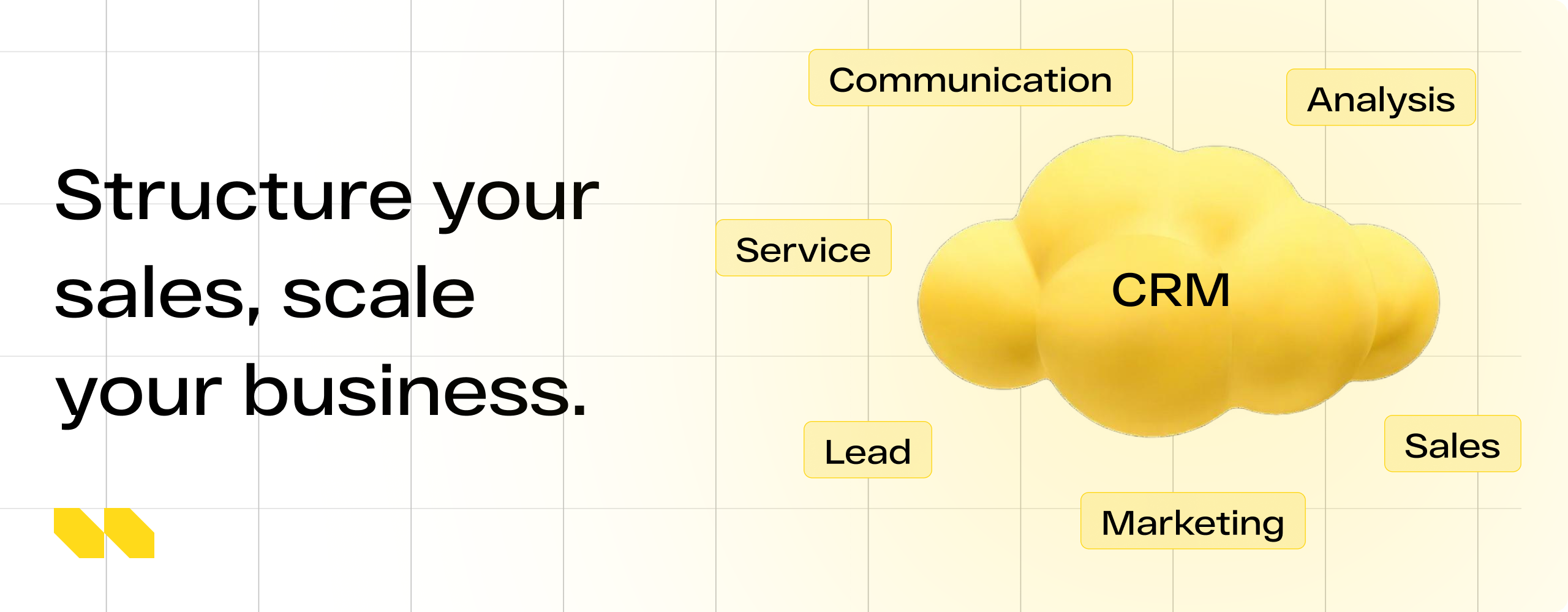
What Is a CRM System and Why Is It Important for Your Company?
Customer relations are an art. CRM is the tool of that art.
CRM stands for Customer Relationship Management. It acts as your memory of customers, the planner for your sales team, the foundation of your marketing strategy — in short, it's the secret of successful business.
Whether you’re a five-person team or a company with hundreds of employees, having access to customer information is your strongest asset. What product were they interested in? When did they last call? Were they satisfied with the service they received? If you can answer all these questions with a single click, you're already one step ahead.
CRM software not only helps you collect data — it allows you to turn that data into value: understand your customers better, anticipate their needs, and ultimately increase sales. In this article, we’ll highlight the benefits this secret weapon can bring to your company. So let’s dive in.
How Is a CRM System Used and What Problems Does It Solve?
If you’re familiar with confusion, redundancy, and wasted time in managing customer relations, the reason may be simple — lack of a system.
In today’s world, this is a harsh reality for companies that operate without CRM. Yet, CRM is specifically designed to organize such chaos.
What problems does CRM solve?
Loss or forgetfulness of information
Lack of coordination and time waste within the team
Inability to track sales stages
Ineffective and untargeted marketing campaigns
Let’s now explore these in more detail:
1. Loss or Forgetfulness of Information
Customers reach out via various channels: email, social media, phone, office visits, etc. If this data isn’t stored in a centralized system, communication breaks down, messages get lost, and the same customer is asked the same questions by different team members.
Solution: With a CRM system, all customer data — name, contact info, past communications, purchase history, etc. — is collected on a single screen. Any team member can access everything they need with one click.
2. Lack of Coordination and Time Waste Within the Team
When there’s no proper sharing of information or clear task delegation within the team, it leads to serious time loss and coordination issues.
Solution: CRM centralizes tasks and information across team members, enhancing collaboration and reducing wasted time. Each employee’s responsibilities are clearly defined within the system.
3. Inability to Track Sales Stages
When sales stages aren’t monitored, potential customers fall through the cracks.
Solution: The CRM system shows each potential customer’s position in the sales pipeline. This helps teams know exactly what each customer needs at what time, prioritize opportunities, and prevent losses — this is strategic sales management.
4. Ineffective Marketing Campaigns
Campaigns are created, budgets are allocated, designs are made… yet results are poor. Without understanding what the customer wants, when they’re interested, or how they behave, campaigns become ineffective and inefficient.
H3: What Challenges Arise Without a CRM System in Customer Management?
If you find yourself restarting customer management from scratch each time, that’s a clear sign of system absence. In many companies, customer relationships rely on personal notes, individual memory, and repeating the same questions. This stems from not using CRM software.
A more difficult scenario is repeated requests. A customer asked for a quote months ago but never received a reply. They reach out again — but you have no record. As a result, discussions start from scratch, and it may be too late: the customer might have chosen a competitor who responded in time.
Without a CRM system, customer relationships depend on individuals, not on a system. If the responsible employee leaves, all their connections and notes leave with them. That means your customer database is stuck in someone’s brain or desktop files.
This approach is neither measurable, nor analyzable, nor scalable.
H2: What Benefits Does a CRM System Bring to a Company?
Companies that implement a CRM system notice changes quickly. Customer interactions become easier, and internal team operations become more structured.
The biggest advantage is that all customer information is collected in one place — no more hours of searching to find out what someone was interested in, when they contacted you, or what stage they are at.
For the sales team, this system serves as a roadmap. It allows tracking of customer progress in the pipeline, ensures timely actions, and helps capture opportunities.
Marketing becomes smarter. Instead of sending the same message to everyone, CRM segments your audience so you can tailor offers to each group — and that brings better results.
Teamwork also improves. Tasks, notes, and statuses are clearly visible in the system — no more wondering who’s doing what.
In the end, it becomes clear once again: CRM is the key to managing a business more intelligently and efficiently.
H3: What Steps Should You Take to Start Using CRM with Birainy?
Work life is already fast-paced — calls, messages, requests, meetings... Keeping everything in one place and under control is a different kind of stress. If you often find yourself thinking:
“When did this customer message us?”
“What were they interested in?”
“What did we last send them?”
— then it’s time for a CRM system. And we’re the ones to build it for you.
First of all, your time is valuable. Doing the same thing twice, asking the same question to different people, saving the same info in multiple files — those days are over.
With the CRM system we develop for you:
- You automate routine tasks — calendar reminders, task sharing, request responses work on their own.
- You get to know your customers better — who bought what and when, what they were interested in, what they returned for — it’s all in front of you.
- You build deeper relationships — every interaction becomes part of an ongoing, transparent connection.
If you want to manage your work more easily, more controllably, and more systematically — what are you waiting for?
Starting CRM implementation with Birainy isn’t starting from scratch — it’s starting one step ahead.